

The city’s dynamic development brought about not only positive effects. As Dallas grew in population, so did its crime rate. In this regard, a legal framework was established with the primary goal of ensuring obedience to the laws. As a result, the Dallas County Criminal Courts Building became the location where all order violators were sentenced and served their time. Find out more at dallas-future.
Beginnings of the Dallas County Criminal Courts Building
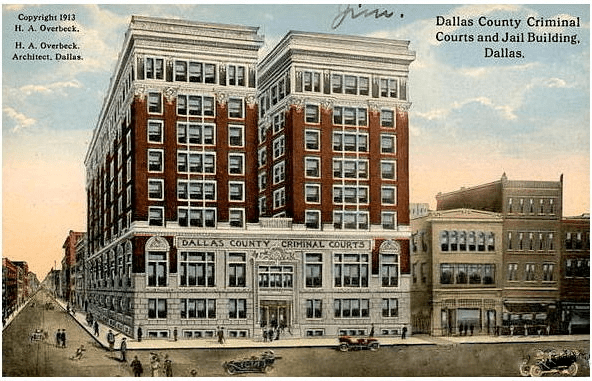
The Dallas County Criminal Courts Building was opened in 1915. Since its inception, the facility has been characterized as one of the most modern and stylish prisons in the United States of America. The project was designed by H. A. Overbeck. The designer created a skyscraper-like modern administrative building in the Italian Renaissance style, which cost about 550 thousand dollars.
The Dallas County Criminal Courts Building is made up of 11 stories that hold administrative offices, trial rooms and prison cells for men and women. The key advantages of this structure are its complete fire resistance and advanced technical features. For example, the prison includes special cells with soft walls for mentally ill inmates.
The building designed by Overbeck was intended to serve as a model for other similar structures, and it was once considered one of the greatest in the country. Unfortunately, it became famous for more than just its architecture. The Dallas County Criminal Courts Building served as the site of an investigation on one of history’s most high-profile events: the assassination of John F. Kennedy, the 35th president of the United States. Jack Ruby, who shot and murdered Lee Harvey Oswald, was tried in the halls of this court building. Following the court sessions, Ruby was escorted to his cell, which offered a view of Dealey Plaza.
Reconstruction of the building
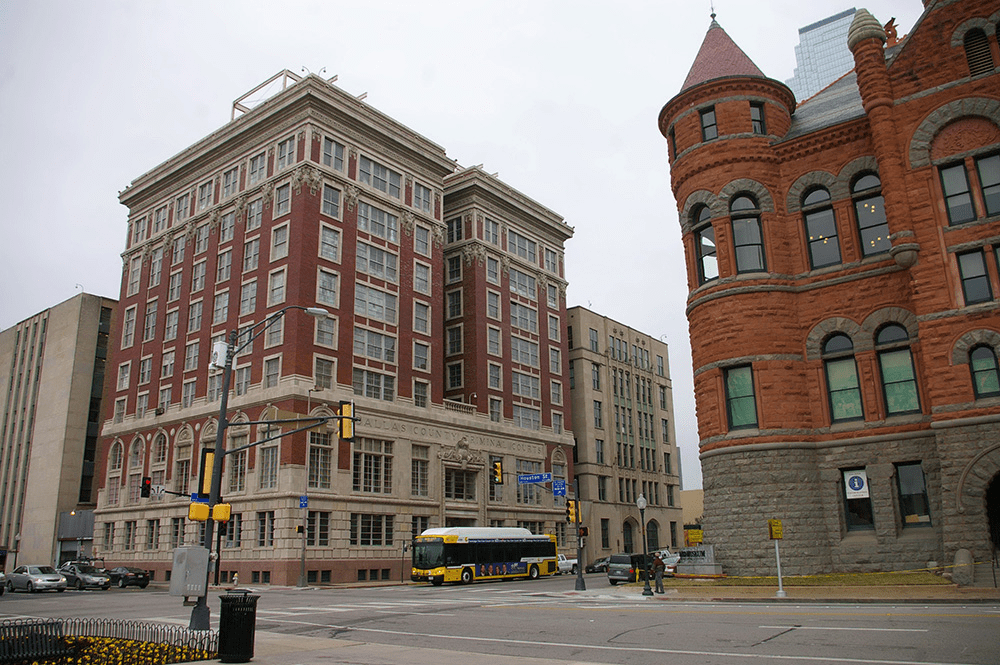
The Dallas County Criminal Courts Building renovation was a CEC project that they wanted to make a reality in order to preserve a piece of the city’s history. Its walls have witnessed not only the imprisonment of Jack Ruby but also served for the incarceration of Clyde Barrow. In addition, it was here that the first woman in the history of Texas served as a judge. Therefore, restoring the structure while conserving its historical importance proved to be a difficult task. The head of CEC Brad Smith made a comment on this occasion. According to him, the architects and builders involved in the reconstruction process completely rebuilt and recombined the three structures. This list comprises the Criminal Court Building (constructed in 1915), the Archives Building (completed in 1928) and a chamber added to the Archives Building in 1955.
Nearly a third of the entire area of the Dallas County Criminal Courts Building was decommissioned in 2000. Rodents damaged electrical wiring, marble wall panels fell off and the heating, ventilation and air conditioning system barely functioned. This is hardly surprising given that the facility has been in operation for nearly a century.
During the reconstruction process, the three previously mentioned buildings were merged into one. This enabled the centralized management of mechanical, electrical and other critical infrastructures. Since then, the renovated building has qualified for WELL Silver and LEED Gold certifications. Furthermore, since historical preservation was an important aspect of the renovation, the majority of the walls and ceiling were left intact. However, during the dismantling of some rooms, numerous historic sites were discovered, including door signs and drinking fountains labeled “Only for whites” as well as antique wooden benches from the 1920s.